 Crypto
The Bitcoin cycle
Is the Bitcoin Halving Cycle Dead?
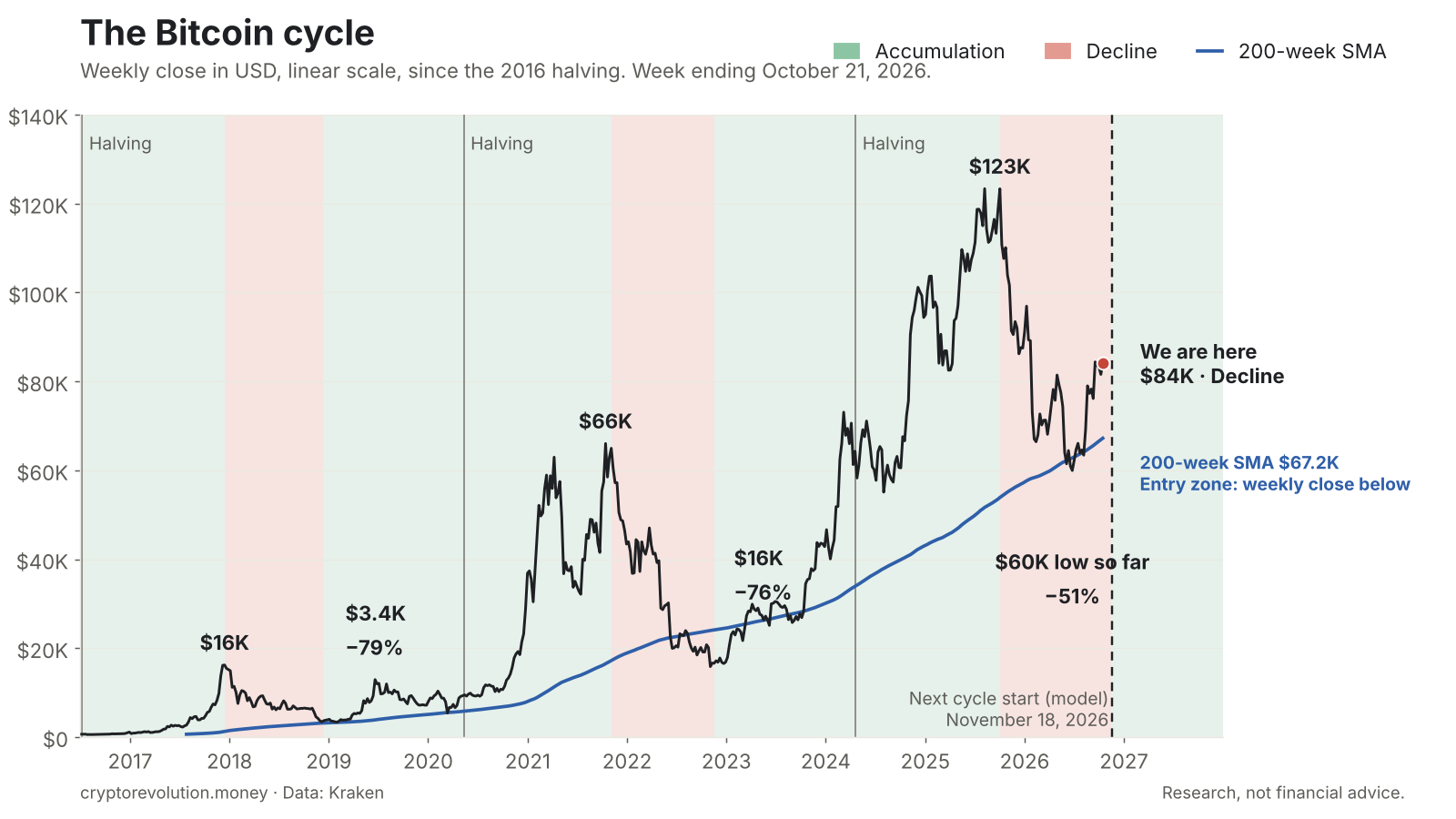
In short: No, but it has changed. The halving still sets the rhythm of the market: every cycle peak so far came about a year and a half after a halving. What has changed is how far the price swings. In June 2026, Bitcoin reached its 200-week moving average, historically a good buy zone, about five months before the decline phase was due to end and after a fall of only about half. Institutional money is the main reason.
The halving cycle in one paragraph
Roughly every four years, the number of new bitcoin created per block is cut in half. Each halving has been followed by the same pattern: a strong advance, a peak, a deep decline and a quiet accumulation phase before the next halving. I explain the cycle in detail in the free ebook Profitable Investing in BTC and Altcoins. In my model, the current decline phase began after the peak in October 2025 and ends around 18 November 2026.
Why the 200-week moving average matters
The 200-week simple moving average is the average weekly closing price of the last 200 weeks, a little under four years. That is about one full halving cycle, so it works like the market’s long-term cost basis. Bitcoin has rarely traded below it, and when it has, it has been near the end of a decline phase. Buying below it has historically paid off over the following cycle.
In the last three cycles it played out like this:
| Cycle | Peak weekly close | Peak vs. 200-week average | Fall to the low | Lowest close vs. 200-week average |
|---|---|---|---|---|
| 2017–2018 | $16,200 | 12.7× | −79% | Touched it, 2% above |
| 2021–2022 | $66,000 | 4.0× | −76% | 34% below |
| 2025–2026 | $123,400 | 2.4× | −51% so far | 5% below |
Weekly closes on Kraken. Kraken’s weeks run Thursday to Wednesday, so peaks differ slightly from Sunday closes.
Why the buy zone came early this time
Look at the third column. At the 2017 peak, Bitcoin traded almost 13 times above its 200-week average. In 2021 it was four times. In 2025 it was less than two and a half times. Each peak has come closer to the long-term average, so each decline needs to fall less to reach it.
That is why the 200-week average was reached early in this cycle. In 2022, Bitcoin had fallen 70 percent before it first closed below the average. This time, a fall of 50 percent was enough. Bitcoin first closed below the average in early June 2026, about five months before the decline phase was due to end. It stayed below it for five weeks, never more than 5 percent under, and then climbed back above it.
In 2022 the price also reached the average months before the low, but then kept falling until it was a third below it. This time buyers stepped in almost immediately. The question is who those buyers were.
How institutional money has changed the game
When the last cycle peaked in 2021, the largest Bitcoin buyers were private investors and a handful of crypto funds. Today the picture is very different.
- Spot ETFs. Since January 2024, Bitcoin can be bought like any share. By late October 2026, US spot Bitcoin ETFs held about 1.29 million BTC, more than 6 percent of all bitcoin in circulation. BlackRock’s fund alone held over 810,000 BTC.
- Treasury companies. Listed companies now hold Bitcoin on their balance sheets. Strategy, the largest, held 848,000 BTC in early October 2026.
- Retirement accounts and wealth managers. ETFs put Bitcoin into IRAs, 401(k)s and model portfolios. That money tends to rebalance on a schedule and buy when prices fall, instead of selling in a panic.
Together, the US ETFs and Strategy alone hold more than a tenth of all bitcoin. This changes the shape of the cycle in three ways.
Smaller peaks. Much of the new demand is steady and long-term, and less of it is euphoric. Bitcoin rises with less mania, so the peak ends up closer to the long-term average.
Shallower declines. Large holders who think in years and rebalance on a schedule buy weakness that private investors used to sell. This is how a fall of about half could reach a level that once took a 70 to 80 percent crash.
A market that moves with the rest of the world. Bitcoin is now held next to stocks and bonds, so it reacts more to interest rates, liquidity and credit markets. When risk is repriced across markets, Bitcoin feels it too, as I wrote this week in Bond Markets Are Signaling a Correction. At the same time, I see institutional money rotating out of the Magnificent Seven and AI stocks and into Bitcoin and the leading altcoins. That is a new source of demand that did not exist in earlier cycles.
So, is the halving cycle dead?
The timing says no. The 2017 peak came about 17 months after the 2016 halving, the 2021 peak about 18 months after the 2020 halving, and the October 2025 peak about 18 months after the 2024 halving. The rhythm is intact.
What has changed is the size of the swings. The cycle is maturing, as most markets do when large, long-term investors arrive. The peaks are lower relative to the trend, the declines are milder, and the long-term buy zone can be reached before the calendar says the cycle is over.
For investors, that means using both tools together. The halving cycle tells you roughly when the risk is highest and when a new cycle is likely to start. The 200-week moving average tells you where prices have historically been attractive. And macro, from credit markets to central banks, tells you how deep a decline can go before the next cycle begins.
I track all three every week in the free Weekly BTC Cycle Update. The Model Portfolio applies the same method to twelve tokens with US spot ETFs, with entry, hold and exit zones every week.
Get the Weekly BTC Cycle Update
Where Bitcoin is in its cycle, the key price zones and what to watch next. A 5-minute read every week, free. Plus the ebook Profitable Investing in BTC and Altcoins as PDF and EPUB.
You'll get a confirmation email first. One email a week, unsubscribe anytime. See the privacy policy.
Sources
- CryptoETF Today: How much Bitcoin do ETFs hold? (October 27, 2026)
- TradingKey: Strategy holds 848,000 BTC (October 2026)
- Decrypt: Bitcoin hasn’t broken the 4-year cycle yet, says 21Shares (June 2026)
- Bitcoin prices and 200-week moving average: Kraken weekly data, week ending October 21, 2026
This article is for educational purposes only and is not investment, tax or legal advice. It does not take your personal situation into account. Do your own research and speak to a qualified advisor before making investment decisions. The author may hold the assets discussed.