 Crypto
Weekly BTC Cycle Update · Week 45
Binance Hack Initiated BTC Price Fall
In short: Hackers stole about $6.3 billion from Binance, the largest crypto heist on record, and Bitcoin fell back to its 50-week moving average. US spot Bitcoin ETFs saw their largest daily outflow of October, and the weekly SMI shows the momentum is not there for price rises.
Where Bitcoin stands in its cycle
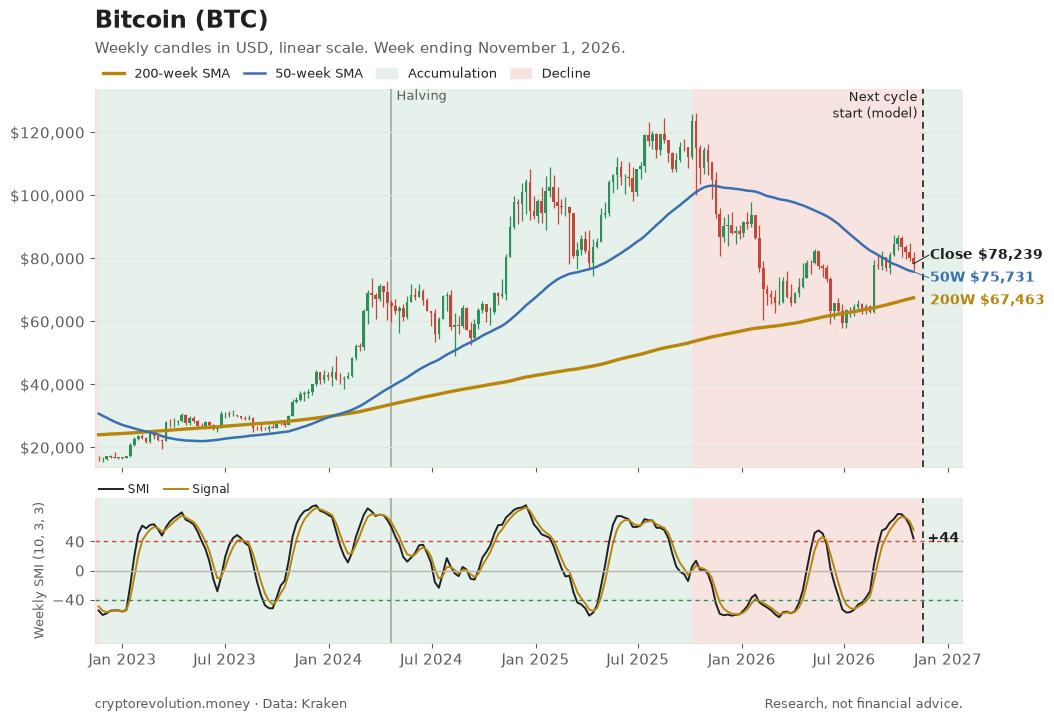
Bitcoin closed the week on Sunday at $78,239, down from $80,048 a week earlier. The weekly SMI, a momentum indicator that measures where the price sits within its recent range, is now at +44, having crossed below the signal line, which means the momentum is not there for price rises. Price touched the 50-week moving average during the week.
It could take until January or February 2027 to build a bottom if risk is repriced in all markets.
Key levels
- Resistance: $87,000
- 50-week moving average: $75,700
- 200-week moving average: $67,500
Bitcoin entry zone: a weekly close below the 200-week moving average, now at $67,500. Historically, this has been a good place to buy.
Bitcoin could test it again or go even lower if markets reprice risk.
ETF flows are not helping for now. US spot Bitcoin ETFs lost $643 million on Friday, their largest daily outflow of October, and ended the week $202 million lower. Ether ETFs lost $431 million over the week. The weekly SMI will need to correct below 0 before a new bottom can form.
The largest crypto heist on record
Binance suffered the largest cyber heist in cryptocurrency history after hackers compromised its hot wallets and stole approximately $6.3 billion in digital assets. The breach began on October 29, when attackers gained access, initially linked to a compromised engineer’s laptop, and drained funds across multiple blockchains within minutes. Blockchain intelligence firms and the FBI attribute the attack to North Korea’s “TraderTraitor” hacking unit. It triggered a temporary suspension of withdrawals and a sharp downturn across the crypto market.
Binance has promised to absorb the full financial impact. Working with law enforcement and partners like Tether and Circle, it froze roughly $3 billion on-chain, and it has set aside over $6.34 billion from its company funds and its Secure Asset Fund for Users (SAFU) to cover the loss. Withdrawals resumed over the weekend, and a fresh Proof of Reserves is due on 2 November.
The hack highlights the risk of holding tokens on centralized exchanges instead of cold wallets. Not your keys, not your coins.
Google enters institutional custody
In other news, Google announced its entry into institutional crypto custody on October 28. It unveiled its Google Multi-Party Compute (MPC) custody security platform at its first Digital Assets Symposium in New York. Rather than serving individual traders, it targets banks and major financial institutions, with a commercial launch planned for early 2027.
What I am doing
I am waiting as I want to see how this plays out. The US midterm elections are on 3 November and markets could correct after that. The recent rally did break the market structure of the decline with a higher high. Now the market needs to confirm it by staying above the June low at $57,700, while the SMI corrects and builds a healthy bottom zone. Next week we will take a look at how low Bitcoin could go if markets reprice risk assets and AI stocks specifically.
The Model Portfolio applies this method to a core portfolio of eight tokens, with entry and exit zones every week, and tracks all 16 tokens with US spot ETFs. Launch price $49 a year until 17 November.
Get the Weekly BTC Cycle Update
Where Bitcoin is in its cycle, the key price zones and what to watch next. A 5-minute read every week, free. Plus the ebook Profitable Investing in BTC and Altcoins as PDF and EPUB.
You'll get a confirmation email first. One email a week, unsubscribe anytime. See the privacy policy.
Sources
- CBS News: Binance hack and North Korea attribution
- Decrypt: Binance sets aside $6.34B to cover hack losses
- Bitcoinist: Bitcoin ETF outflows hit $643M
- Phemex: Google MPC custody service, early 2027 release
- Bitcoin prices and moving averages: Kraken data, week ending November 1, 2026
This article is for educational purposes only and is not investment, tax or legal advice. It does not take your personal situation into account. Do your own research and speak to a qualified advisor before making investment decisions. The author may hold the assets discussed.